Now on Amazon!

Why Do Cats Knock Things Over? The Answer
When your cat's paw contacts an object and it moves, the brain fires the same response as detecting live prey. This is not mischief. This is precision — and it has not changed for thousands of years.
6/11/20263 min read
The Question You Already Know the Answer To
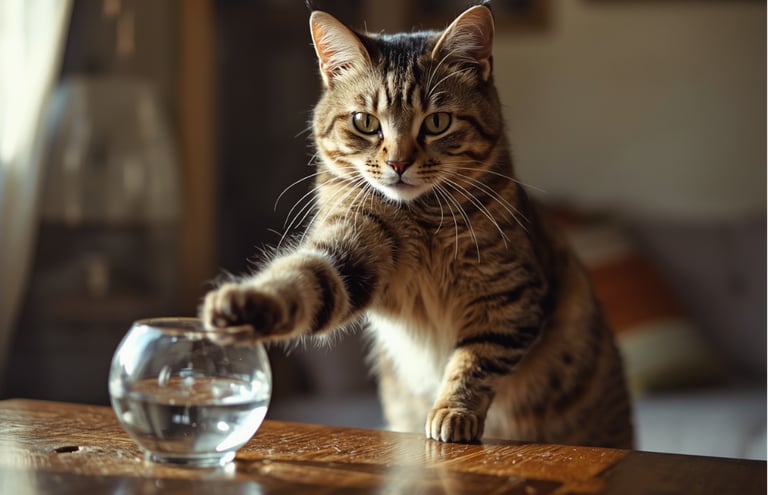
You are standing in the kitchen. Your cat is on the counter. There is a glass within reach. You make eye contact. The paw moves slowly, deliberately, to the rim of the glass.
You say "no." The paw pauses. Then — without breaking eye contact — pushes it off the edge.
This is not chaos. This is not rebellion. This is four thousand years of instinct, completely intact, playing out on your kitchen counter before you have had your coffee.
The Science: Why Cats Knock Things Over
The behaviour has a name in animal science: object interaction. And it is rooted in something cats have been doing long before they lived with humans.
Cats are hardwired hunters.
When a cat's paw contacts an object and that object moves — even slightly — it triggers the same neural pathway as detecting live prey. The brain processes the movement as: this thing might be alive. The instinct that follows is ancient and automatic: assess, confirm, act.
Watch closely next time. Your cat does not swipe randomly. They tap first. Then pause. Then tap again. They are running a prey assessment. The object is being tested for signs of life — its weight, its resistance, the way it responds to pressure.
That is not mischief. That is a predator at work. Precise, methodical, unhurried.
The Second Theory: Your Cat Has Trained You
There is another explanation — and it says less flattering things about us.
Some cats have learned that knocking things over produces a reliable reaction from their humans. You look up from your phone. You say something. You get up. You engage.
For a cat seeking attention, this is a perfectly engineered system. The action costs nothing. The reward — your attention — is immediate and consistent. Over time, the behaviour becomes deliberate not because of hunting instinct but because of operant conditioning.
Your cat has trained you. Not the other way around. They identified a behaviour that reliably produces the outcome they want, and they repeat it.
The fact that you are reading this article suggests the training is working.
The Ancient Egyptian Connection
The ancient Egyptians understood this instinct better than anyone alive today.
They kept cats not as companions — not at first — but as guardians. Egypt's grain stores were the lifeblood of the empire. Rats and mice that infiltrated those stores threatened not just food but civilization itself. The pharaoh's pantry, the city's supply lines, the survival of entire populations — all of it vulnerable to rodents.
Cats solved the problem with the same quality you watch every morning on your kitchen counter: precision.
That calculated paw. That prey assessment. That unhurried, methodical confirmation before the final act. What looks to us like mischief looked to the Egyptians like a divine gift. The goddess Bastet — depicted as a cat or as a woman with a cat's head — was the embodiment of this protective instinct. Revered. Worshipped. Sacred.
The cat that knocks your coffee mug off the counter is running the same instinct that once cleared the pharaoh's pantry. The instinct has not dulled. The prey is just less interesting.
What This Means For You
Your cat is not broken. They are ancient. And that distinction matters.
When you understand that the behaviour is instinctual — not spiteful — it changes how you respond to it. Punishment is ineffective and confusing for a cat acting on deep biological programming. Redirection is far more useful.
What actually helps:
Give them something that earns the instinct properly. A scratcher they can engage with. Toys that move unpredictably. Environmental enrichment that lets them hunt, assess, and act in ways that are satisfying rather than disruptive.
The paw does not need to be stopped. It needs to be pointed in the right direction.
The Closing Thought
Somewhere between four and five thousand years ago, a cat sat in an Egyptian grain store and watched a rat move through the shadows. The paw went out. The assessment was made. The rat did not survive the encounter.
This morning, your cat sat on your counter and watched a glass of water sit perfectly still. The paw went out. The assessment was made. The glass did not survive the encounter either.
The instinct is unchanged. The stakes are considerably lower.
Your cat is not being difficult. They are being exactly what they are. The least you can do is give them something worthy of that.
About PetGlyph
PetGlyph creates premium pet supplies inspired by the ancient Egyptians — the first civilization to truly understand the animals in their care. Every product is designed for the pet owner who believes their animal deserves something better than ordinary.
Discover PetGlyph Products
Sign up to the PetGlyph blog for more ancient wisdom, modern pet care, and the occasional reminder that your cat has been running the household since 3100 BC.
Share this article if your cat has ever made deliberate eye contact before pushing something off a surface.

PetGlyph
Check our Social Media!
Contact
Newsletter
info@petglyph.com
© 2024. All rights reserved.