Coming soon on Amazon.

Why Do Cats Purr? The Science and the Sacred Truth
Cats purr between 25–150 Hz — a frequency science links to healing. Discover what your cat's purr really means and what ancient Egyptians understood thousands of years ago.
EDUCATION
5/24/20244 min read
A Cat Does Not Only Purr When Happy
This is the part most people do not know.
Cats purr in a wide range of emotional states — not only contentment. They purr when they are:
Relaxed and content. The classic purr. Long, steady, rhythmic. Your cat is at ease and everything is as it should be.
Anxious or stressed. Cats will purr during veterinary visits, thunderstorms, or unfamiliar situations. In these cases, purring is self-soothing — the same way a human might hum quietly to calm themselves.
In pain or unwell. This is the one that surprises people most. Cats often purr when they are injured or ill. Scientists believe this is the body's self-repair mechanism activating — the vibration frequencies promoting healing from within.
Communicating a need. Researchers have identified a specific type of purr — called a solicitation purr — that cats produce when they want something, typically food. It embeds a subtle cry frequency within the purr that humans find difficult to ignore. Your cat knows exactly what it is doing.
Learning to distinguish these purrs takes time and attention. But it is one of the most intimate things you can do as a cat owner — to begin truly listening to what your cat is telling you.
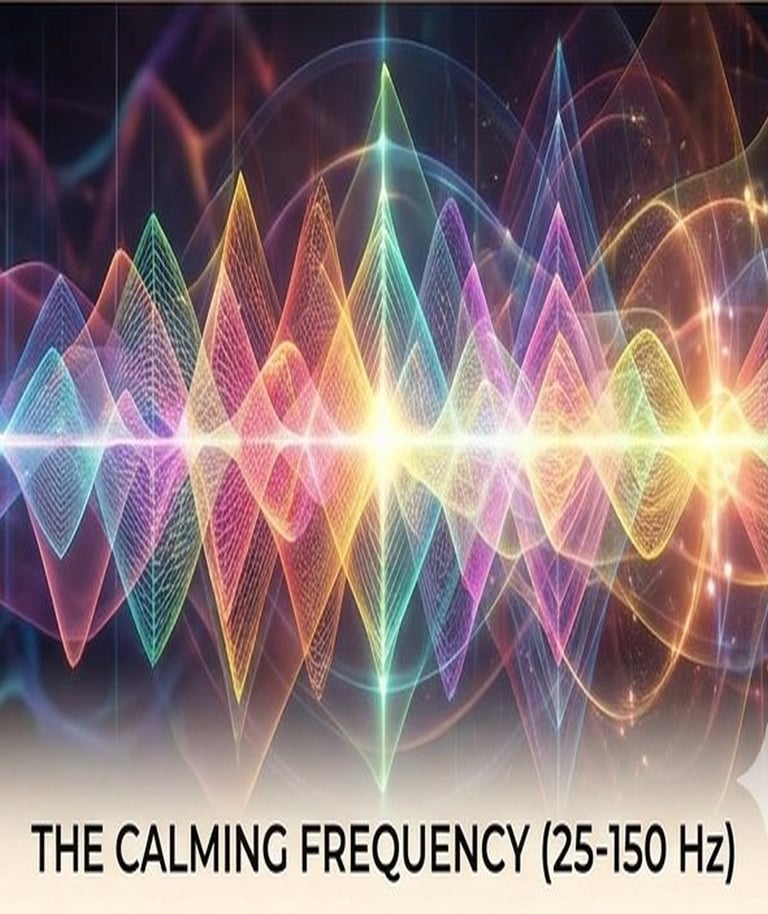
The 25–150 Hz Frequency — What Science Actually Says
The research into therapeutic vibration is not new, but its
application to cats has only gained serious attention in recent
decades.
Studies conducted on domestic cats found that the majority purr
at frequencies between 25 and 50 Hz — the precise range most
associated with bone healing and density improvement in
scientific literature. The hypothesis that cats evolved to purr partly as a self-healing mechanism is now well-supported.
For context: astronauts returning from space suffer significant bone density loss due to weightlessness. Researchers studying solutions have looked specifically at vibrational therapy in the 25–50 Hz range as a potential countermeasure.
Your cat has been doing this instinctively for millions of years.
The Solicitation Purr — The One
You Cannot Ignore
In 2009, researchers at the University of Sussex published a study on
what they called the solicitation purr. When cats want to be fed, they
produce a purr that contains a high-frequency cry embedded within the
lower purr frequency. Humans respond to this sound with a sense of
urgency — it triggers something primal and caregiving in us.
Cats appear to have developed this specific sound through coexistence with humans — learning, over thousands of years, exactly which frequencies we find hardest to ignore.
It is, in other words, a perfectly evolved tool for manipulation. And it works every time.
Ancient Egyptians and the Sacred Sound
The ancient Egyptians did not have access to vibrational frequency research. But they did have something arguably more valuable — thousands of years of careful, reverent observation.
Cats were kept in Egyptian homes, temples and palaces not only as hunters of vermin, but as presences. As companions whose proximity was believed to bring protection, calm and good fortune to a household.
Bastet — the cat goddess — was associated not only with grace and protection, but with fertility, healing and the home. The qualities attributed to her are remarkably consistent with what we now understand about the physiological effects of a purring cat: calm, healing, protection from harm.
It is difficult to know whether the ancients consciously associated the purr with healing. But it is not difficult to believe that they felt it. That the sound of a cat purring in a room made that room feel different — safer, calmer, more complete.
They honoured what they sensed. Science eventually confirmed what they knew.
What Your Cat's Purr Is Telling You
Now that you understand the range of reasons a cat purrs, here is how to begin reading yours:
A long, slow, rhythmic purr during rest or while being held — contentment. This is the one. Savour it.
A high-pitched, slightly urgent purr combined with eye contact at meal times — the solicitation purr. You are being managed. It is fine to comply.
A purr during a vet visit or thunderstorm — self-soothing. Your cat is regulating their own nervous system. Stay calm, stay present, let them work through it.
A purr while visibly unwell or hiding — pay attention. A cat that purrs while showing other signs of illness may be attempting to self-heal. This warrants a vet visit.
A purr that stops and starts unexpectedly — your cat is communicating something specific. Sit with them. Pay attention to what else they are doing with their body.
The purr is a language. Learning it takes time and patience — but the conversation, once you begin to hear it, is extraordinary.
Let Them Purr
There is something remarkable about the idea that an animal evolved a sound that simultaneously calms them, heals them, communicates their needs, and makes the humans around them feel at ease.
The purr is one of the most sophisticated things in your home. More sophisticated, certainly, than anything plugged into a wall.
Ancient Egyptians built temples to the goddess who embodied it. Modern science measures its frequency and confirms its power.
You just need to sit still long enough to hear it.
At Pet Glyph, We Pay Attention
Pet Glyph was built on the belief that understanding your pet begins with truly seeing them — and truly listening to them. The ancient Egyptians excelled at this. We carry that practice forward.
Our collection is coming soon. Join the inner circle for early access and first updates.
Share this post: If this changed how you think about your cat's purr — share it with someone who needs to hear it.
#PetGlyph #CatPurring #WhyCatsPurr #CatFacts #CatCare #AncientEgypt #Bastet #CatScience #CatLovers #PetEducation #AncientEgyptianWisdom #CatBehaviour



PetGlyph
Check our Social Media!
Contact
Newsletter
info@petglyph.com
© 2024. All rights reserved.