Coming soon on Amazon.

Why Do Cats Sleep So Much? The Science Behind It
Cats sleep 12–16 hours a day — and it's not laziness. Discover the science behind cat sleep and what ancient Egyptians understood thousands of years ago.
CAT CAREPET CARE
PetGlyph
5/8/20245 min read
You have probably watched your cat curl into a perfect circle on the sofa, close their eyes, and completely disengage from the world — including you. And you have probably wondered, at least once, whether something is wrong.
Nothing is wrong. In fact, everything is exactly right.
* The Science Behind the Sleep:
Cats sleep between 12 and 16 hours a day. Some cats — particularly kittens and older cats — sleep as many as 20 hours in 24 hours. This is not a character flaw. It is not indifference, though the evidence may occasionally suggest otherwise. It is biology, operating precisely as it was designed to.
Cats are crepuscular animals — meaning they are naturally most active at dawn and dusk. These are the hours when their prey is most vulnerable. Between those windows of activity, their bodies enter deep rest cycles that restore the muscular and neurological energy required for what they do best: hunting.
Unlike humans, who are built for sustained endurance, cats are built for explosive precision. A cat in pursuit of prey accelerates from stillness to full sprint in fractions of a second. Their muscles require deep, restorative sleep to perform at that level. Every nap is preparation. Every stretch before sleep is a reset. Their stillness is not idleness.
It is readiness.
* What Happens When a Cat Sleeps:
Not all cat sleep is the same. Like humans, cats cycle through
different stages of sleep — light sleep and deep sleep, known as
REM sleep.
During light sleep, a cat remains partially alert. You may notice their ears twitching or their eyes moving behind closed lids. This is the stage where they are most easily woken. A cat in light sleep is still, in some sense, on duty.
During deep REM sleep, the body does its most important work — repairing tissue, consolidating memory, and restoring energy. This is when you might see your cat twitching, making small sounds, or moving their paws as if chasing something in a dream. Which, in all likelihood, they are.
A cat that regularly cycles through both stages is in excellent health. Disrupted sleep — from stress, illness, or environmental changes — can have real consequences for a cat's physical and mental well-being.
*12–16 Hours. Every Day:
The number sounds extraordinary until you consider the physics of what a cat's body is asked to do.
A domestic cat shares approximately 95% of its genetic code with the tiger. The hunting instinct, the muscle composition, the predatory reflexes — all of it is still there, intact, waiting. The fact that the primary prey in your home is a toy mouse or a sock does not change the biological programming.
That programming requires significant energy to maintain. And energy requires rest.
*Ancient Egyptians Understood This 5,000 Years Ago:
Long before modern veterinary science confirmed what we now
know about cat sleep, the ancient Egyptians had already reached the same conclusion — through observation, reverence, and a depth of attention to the natural world that the modern era rarely matches.
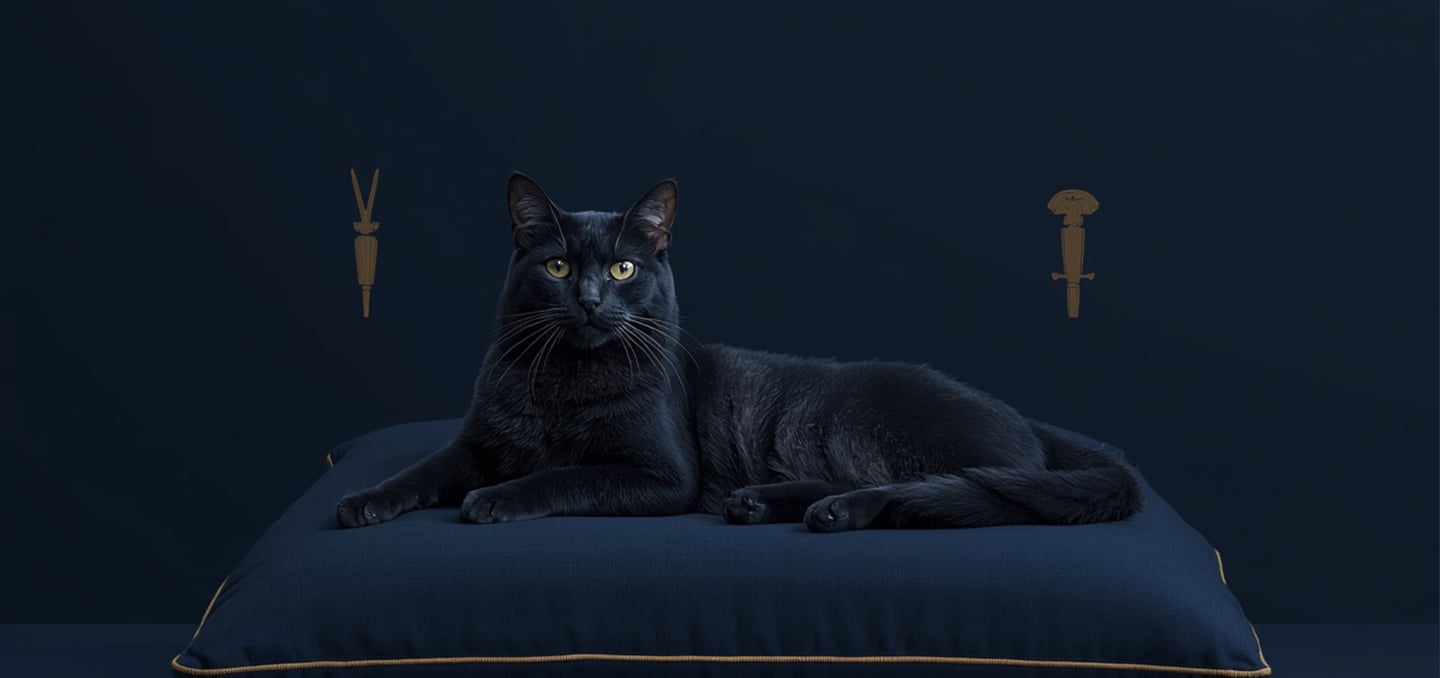
The sacred cats kept in Egyptian temples were never disturbed during rest. Their sleep was not merely tolerated — it was honoured. Ancient Egyptians understood that the stillness of a resting cat was not absence. It was the presence of a different kind. A quiet, sacred state that demanded respect from everyone around it.
Bastet — the goddess most closely associated with cats — was worshipped not only as a deity of protection and fertility, but as an embodiment of grace, precision and controlled power. Qualities that are, of course, perfectly expressed in a cat who spends sixteen hours a day sleeping and then knocks an entire glass of water off a table with one deliberate paw.
The ancient Egyptians did not see the sleeping cat as inactive. They saw it as complete.
* What a Sleeping Cat Is Actually Telling You:
A cat that sleeps deeply and undisturbed is a cat that feels safe.
This is perhaps the most important thing to understand about cat sleep. Cats are prey animals as well as predators. In the wild, deep sleep is a vulnerability — a moment when they can be caught off guard. A cat that chooses to sleep deeply in your home is making a statement about how safe they feel in your presence.
It is, in its own feline way, a profound compliment. When your cat curls up on your sofa, or in the warmest corner of the room, or on that pile of clean laundry you were definitely going to fold — they are telling you that they trust their environment. That they feel protected. That they are comfortable enough to be vulnerable.
Disturbing sleep regularly — picking them up when they are deeply resting, making sudden loud noises, or moving them from their chosen spot — can increase stress and anxiety over time. It tells the cat, on an instinctive level, that they cannot fully relax. That something may require their attention at any moment.
*How to Support Your Cat's Sleep:
Supporting your cat's sleep is one of the simplest and most impactful things you can do for their long-term wellbeing. Here is what makes a real difference:
Give them a dedicated space. Cats sleep best in a location they have chosen and claimed as their own. A warm, elevated spot — where they can see the room but feel sheltered — is ideal. Respect that space as theirs.
Keep their environment consistent. Cats are creatures of routine. Sudden changes to furniture layout, new pets, loud guests, or shifts in your own schedule can all disrupt their sleep patterns. When change is unavoidable, give them extra quiet time to adjust.
Let them sleep undisturbed. This is the simplest rule and the hardest one for cat owners to follow. When your cat is deeply asleep — when they are twitching and dreaming and completely elsewhere — let them be. They will return to you when they are ready. They always do.
Watch for changes. A cat that suddenly sleeps significantly more or less than usual, or who seems restless and unable to settle, may be signalling a health issue worth a conversation with your vet. Know your cat's normal patterns so you can notice when something shifts.
*The Next Time Your Cat Ignores You in Favour of a Nap:
Know this: they are not ignoring you. They are honouring thousands of years of instinct. They are doing exactly what their biology, their ancestry, and five millennia of human reverence have confirmed is right and necessary.
Let them rest. They are preparing for something important.
(Probably knocking something off your counter.)
*At Pet Glyph, We Believe This Too
Pet Glyph was built on the belief that the animals we share our homes with deserve more than average. Not just better products — but better understanding. The ancient Egyptians revered their cats not because they were sentimental, but because they paid attention. They watched. They learned. They honoured what they saw.
We think that instinct — to truly see the animal in front of you — is worth carrying forward.
Our collection is coming soon. In the meantime, join the inner circle for early access and exclusive updates.
Ancient Wisdom. Modern Pets. Timeless Care.
— Pet Glyph
#PetGlyph #CatCare #CatFacts #AncientEgypt #Bastet #WhyCatsSleep #CatScience #CatLovers #PetEducation #AncientEgyptianWisdom


PetGlyph
Check our Social Media!
Contact
Newsletter
info@petglyph.com
© 2024. All rights reserved.